What to Watch While They're Building: Catching Pool Quality Problems Before It's Too Late
Photo: DS Pugh , CC BY-SA 2.0, via Wikimedia Commons
Here's something nobody tells you when you hire a pool builder: your best chance to catch a problem is while the work is still happening. Once that plaster cures and the water fills up, a lot of issues become much harder — and much more expensive — to fix. The good news is you don't need a contractor's license to notice when something looks off. You just need to know what you're actually looking at.
This isn't about being the homeowner who hovers over the crew with a clipboard. It's about understanding the specific details that separate a pool that holds up beautifully for twenty years from one that starts showing cracks and headaches by year three.
The Shell Stage: Where Structural Problems Are Born
Before any tile goes up or any plaster goes down, the shell of your pool is the most important thing to pay attention to. For gunite and shotcrete pools — which make up the majority of custom builds in the Richmond area — the shell is sprayed in layers. What you're looking for here is consistency.
Walk around the perimeter after the shell has been applied and look for any spots where the surface appears thin, uneven, or shows a honeycomb-like texture (contractors call this "rebound" buildup, and it's a sign the material didn't bond properly). Those voids can become structural weak points over time. A solid shell should look dense and uniform, almost like the surface of rough concrete.
Also check the depth transitions. If your pool has a shallow end, a deep end, and a step or bench area, the curves between those zones should be smooth and gradual. Abrupt angles or awkward transitions aren't just aesthetically questionable — they can create stress points in the shell that crack under pressure as the ground shifts through Richmond's seasonal freeze-thaw cycles.
Tile Work: The Detail That Tells You Everything
Tile installation is one of the clearest indicators of a crew's overall craftsmanship. It's visible, it's measurable, and it either lines up or it doesn't.
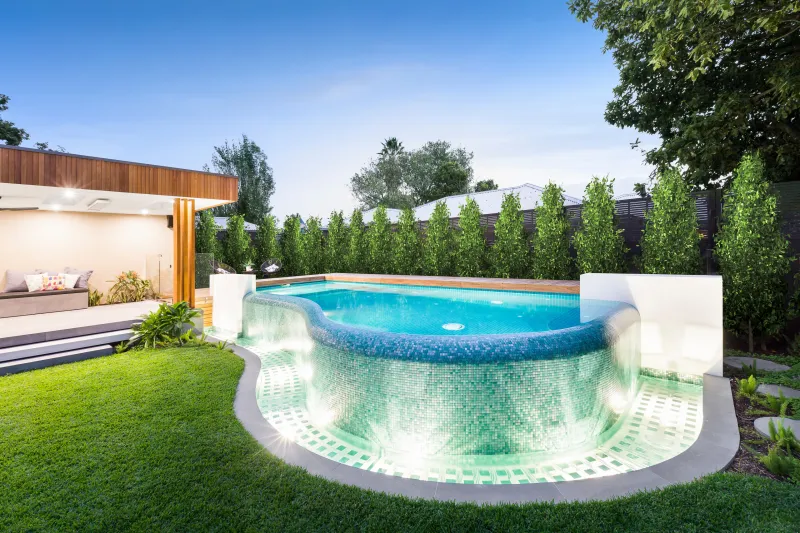
Stand back and look at the waterline tile from several feet away. The grout lines should be consistent in width — not perfectly robotic, but noticeably even. If you see tiles that are slightly higher or lower than their neighbors, creating a ripple effect along the waterline, that's a problem. Uneven tile sits unevenly in grout, and uneven grout cracks and lets water in over time.
Also pay attention to the corners and curves. This is where less experienced tile setters tend to struggle. The tiles should wrap around curved walls and steps cleanly, with cut pieces sized proportionally. If you see a cluster of tiny, awkward slivers of tile jammed into a corner, that's a crew that didn't plan the layout carefully from the start.
Finally, press gently on a few tiles if you can access them before grout is applied. A hollow sound when you tap means the tile isn't fully bonded to the surface beneath it. That tile will eventually pop off — usually right when you've got a yard full of guests.
Plaster and Interior Finish: Reading the Surface
If you're getting a plaster interior finish — whether it's traditional white plaster, quartz aggregate, or pebble — the application process matters enormously. Plaster is mixed and applied by hand, which means human error is always in play.
A good plaster job looks consistent in color and texture across the entire surface. Walk the perimeter and look for blotchy areas, color variation, or sections that appear rougher or smoother than the surrounding surface. These are signs of inconsistent mixing, application at different times without proper blending, or a crew that rushed the job.
Also watch for what's called "trowel marks" — visible swipe lines left behind when the plasterers didn't finish the surface evenly. Some texture is normal and even desirable in aggregate finishes, but directional marks or ridges in a smooth plaster finish are a red flag.
One thing Richmond homeowners often overlook: the curing process matters just as much as the application. Ask your contractor specifically how they handle the startup chemistry and initial fill. Plaster that gets filled too quickly or with improperly balanced water can develop staining and etching within the first few months.
Equipment Placement: The Stuff Nobody Thinks About Until It's a Problem
The mechanical equipment for your pool — the pump, filter, heater, automation controls — isn't glamorous, but how it's installed has real consequences for maintenance, noise, and longevity.
First, check that the equipment pad is level and elevated slightly above grade. Equipment sitting in a low spot will collect water every time it rains, which accelerates corrosion and shortens the life of your components. In Richmond, where summer storms can dump serious rainfall in a short window, this matters more than you'd think.
Look at how the plumbing runs from the pool to the equipment. The pipes should be routed cleanly, supported at regular intervals, and connected with proper fittings — not a series of awkward angles that suggest someone was improvising as they went. Sloppy plumbing creates pressure inefficiencies that make your pump work harder and your energy bills creep up.
Also consider noise and access. The equipment pad should be positioned so that a technician can comfortably reach every component for maintenance without contorting around obstacles. If it looks cramped during installation, it's going to be a nightmare to service in three years.
Deck Grading: The Detail That Protects Your Whole Yard
This one gets overlooked constantly, and it causes serious problems. The concrete or paver deck surrounding your pool needs to slope away from the water — typically about a quarter inch per foot — so that rainwater drains toward your yard, not back toward the pool or, worse, toward your house's foundation.
Bring a small level with you during a site visit and lay it on the deck surface in a few spots. You want to see a consistent, gentle slope away from the pool edge. Flat decking holds water and breeds algae. Decking that pitches toward the pool introduces contaminants and dilutes your water chemistry after every rain.
If you see standing water on the deck during or after construction, flag it immediately. This is much easier to address before the deck is fully cured than after.
The Bottom Line: You're Allowed to Ask Questions
A quality pool builder in Richmond won't be bothered by an engaged homeowner asking reasonable questions during the build. If anything, the contractors worth hiring will welcome it. The ones who get defensive when you point to something that looks off? That's information worth having before the final payment is due.
You don't need to become an expert in pool construction. You just need to show up, pay attention, and trust your instincts when something doesn't look right. The details covered here — shell consistency, tile alignment, plaster quality, equipment setup, and deck drainage — are visible to anyone willing to look. And catching one real problem during construction is worth more than a hundred conversations after the fact.